Overview
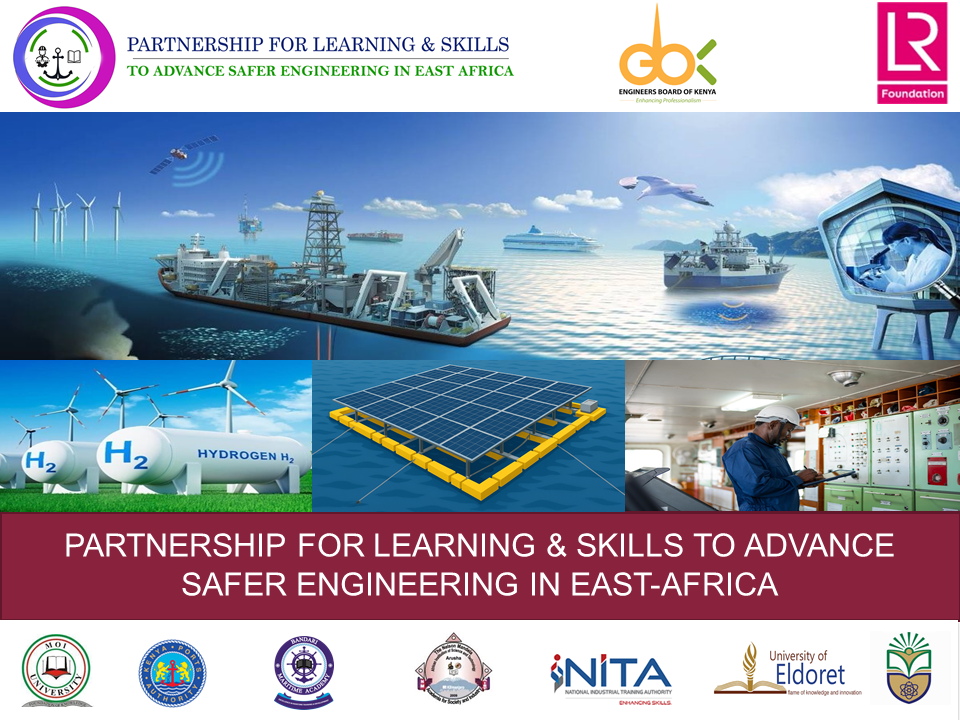
Moi University is implementing a project titled “Partnership for Learning and Skills to Advance Safer Engineering in East Africa.” The initiative seeks to strengthen engineering education and professional training by aligning skills development with emerging industry needs, particularly in the areas of digital transformation and green transition.
As part of this initiative, a Skills Needs Assessment has been conducted to identify the competencies required for engineering students and professionals to effectively contribute to safer and sustainable engineering practices in the energy and maritime sectors in Kenya.
Transitions in the Maritime & Energy Sectors
East Africa is currently experiencing rapid growth in maritime and energy-related infrastructure. Investments in port expansion, logistics corridors, offshore energy exploration, and coastal transport networks are transforming the regional maritime landscape. These developments are essential for supporting economic growth, enhancing regional trade connectivity, and strengthening industrialization efforts.
However, the rapid expansion of maritime infrastructure is occurring alongside a growing demand for skilled engineering professionals capable of designing, constructing, operating, and maintaining complex maritime and energy systems. While infrastructure is expanding rapidly, the supply of engineers and technical professionals with specialized maritime and emerging technology skills has not kept pace. This gap presents challenges related to operational efficiency, environmental sustainability, and safety in maritime operations.
Further, the maritime sector is increasingly adopting energy-efficient ship designs, electrification technologies, hybrid propulsion systems, and renewable energy integration within port operations. Ports are also introducing green port initiatives, such as shore-to-ship power systems, electrified cargo handling equipment, and improved energy management systems.
For East Africa, green energy transitions present both opportunities and challenges. While they provide pathways for sustainable maritime development and environmental protection, they also require new competencies related to fuel safety, energy systems integration, environmental management, and risk assessment. Engineers and maritime professionals must therefore acquire specialized knowledge and practical skills to safely handle, store, and operate systems associated with future fuels and low-carbon technologies.
Digitalization is another major transformation shaping the maritime industry. Technologies such as automation, artificial intelligence, digital monitoring systems, Internet of Things (IoT), and cyber-physical systems are increasingly being integrated into ships, ports, and logistics networks.
Smart ports are now deploying automated cargo handling systems, predictive maintenance technologies, and real-time vessel tracking to enhance operational efficiency and reduce downtime. Similarly, vessels are being equipped with advanced navigation systems, integrated control systems, and data-driven decision-support tools. These technologies enable improved safety, efficiency, and sustainability in maritime operations.
However, digital transformation also introduces new technical and operational challenges. The integration of complex digital systems requires engineers and operators with strong competencies in data systems, automation technologies, cybersecurity, and system integration. In many developing regions, including East Africa, there remains a significant gap between the skills available in the workforce and the competencies required to support these advanced maritime technologies.
Why the Skills-Needs Assessment?
The skills-needs assessment is necessary to provide evidence-based insights into the competencies required by industry and the existing gaps within the current workforce and training systems. The findings will support the development of targeted skilling courses for engineering students and practitioners.
By identifying priority competencies in digital systems, automation, safety leadership, and green energy technologies, the study will contribute to strengthening the region’s engineering capacity and promoting safer, more sustainable maritime operations.
Stakeholders' Workshop
A stakeholders' workshop has been organized whose purpose is to review and validate the findings of the assessment and provide expert input that will guide the development of targeted skilling courses. The workshop will be held on Friday, 20th March 2026 in Nairobi, 8:00am to 3:00pm, at KICD Conference Center
The workshop aims to:
- Present the preliminary findings of the Skills Needs Assessment on digital and green transition skills in the energy and maritime sectors in Kenya.
- Validate the identified priority skills and competency gaps with key industry, policy, and academic stakeholders.
- Obtain stakeholder input on emerging technological, regulatory, and sustainability trends influencing engineering skills demand.
Project Lead:

Prof. Eng. Augustine Makokha (PE, MIEK, MAEE, CEM, REP)
Project Members:


Prof. Eng. Alex Muumbo - TUK Prof. Cyrus Wekesa - University of Eldor


Eng. Grace Onyango - EBK Eng. Monica Atemba - Kenya Ports Authority (KPA)


Dr, Gordiana Philipo - Nelson Mandela African -IST CPA Evans Oyieyo - Bandari Maritime Academy

Ms Suzzanne Kalume - ICT Support Ms Cynthia Mutuku - Projects Office